Debénath & Dibble on the sheer scale of what lies beneath:
Imagine … that during the time of the Acheulian in Europe, which lasted for at least 500,000 years, there was a constant population of 5,000 active tool makers. Imagine also that each of these flintknappers made only ten bifaces per year and perhaps 100 flake tools. Even with such conservative parameters…, this would have resulted in the production of 25,000,000,000 bifaces and 250,000,000,000 flake tools, of which only a minuscule proportion has been collected during the history of Paleolithic research.
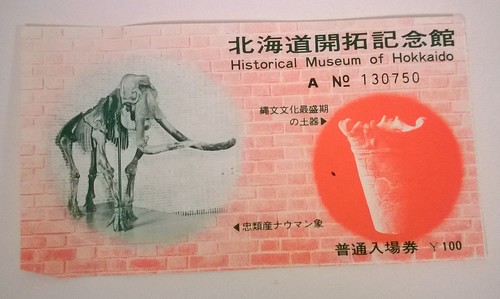
In the entrance hall of the Historical Museum of Hokkaido stand two enormous skeletons — a mammoth and a Naumann’s elephant, another type of woolly, Pleistocene proboscidean native to Japan. By the time I visited the museum at age three or four, I had seen living elephants at the Ueno Zoo in Tokyo and the Maruyama Zoo in Sapporo. The enormous curved tusks arched over my head, and I knew instantly that I was in the presence of something altogether different and wonderful.
An artifact: My mother saved the entrance ticket to the museum
We walked past cases of Jomon pottery and through the dark halls of ethnographic dioramas depicting Ainu lifeways. The museum opened just a few years earlier, in 1971, to commemorate the 100th anniversary of the Western-style colonization of Hokkaido by ethnic Japanese people following the Meiji Restoration. Hokkaido today is full of beautiful Victorian buildings that would be at home in any of the nicer neighborhoods of San Francisco, Chicago, or Seattle. As is typical the world over, the process of colonization did not go well for the aboriginal peoples. But I’ll save a discussion of the complexities of modern Japan as a multiethnic society for another day…
I got scared of the strange, dimly lit mannequins with their beards and furs, so my mother took me outside to walk around on the museum grounds, where we encountered a rock wall of hand stencils like the ones I’d see when I grew older, a motif that ties together Paleolithic cultures the world over.
Despite my fear, from that moment on, I became fascinated with humanity’s shared past. I needed to understand those other people who lived in a time when mammoths and aurochs roamed the open steppe. By the time I was 5 had learned that people who studied deep human history were called archaeologists, and the people who dug up mammoths were called paleontologists. As awed as I was by that mammoth, it was the people who intrigued me. Following the invariable fireman phase and a brief flirtation with wanting to be a ballerina (after seeing the Bolshoi Ballet perform Swan Lake), I knew I wanted to become an archaeologist.
When adults asked me, I would inform them of this fact, to which most would say, “So you want to dig up dinosaurs? That sounds like fun!”
“No,” I would reply, “That’s a paleontologist, like Louis Leakey in Africa. I want to become an archaeologist.”
By the mid-80’s, adults would then follow with “Oh, of course, like Indiana Jones!”
I’d sigh and say, “No, not like him. Indiana Jones is just a grave robber. I want to be like Heinrich Schliemann. He discovered Troy.”
Large proportions of my education having consisted of back issues of National Geographic and old sets of Encyclopædia Britannica, I was, in hindsight, rather insufferable.
There really are moments in the course of your life when it shifts to a new direction. In the years since, I’ve collected Jomon potsherds from carrot fields in Yokohama, participated in digs (the Tategahana Paleolithic site at Lake Nojiri and Tall al-`Umayri in Jordan), held Neanderthal tools in my hand, and pondered axial precession under Newgrange.
And yet, nothing will ever compare to my first sight of a mammoth skeleton that day back in Hokkaido. Some day, perhaps I’ll see one in the flesh…
I’ve begun narrowing my reading down from works about the Paleolithic as a whole to the Middle Paleolithic in particular.
While it’s been fascinating to see perspectives on Neanderthals evolve in popular non-fiction over the last 30 years, immersing myself in stratigraphy, typology, palynology, faunal assemblages, taphonomy, and (most exciting!) spatial organization has proved deeply rewarding. To that end, my reading has incorporated more and more site reports by the likes of Bordes (Combe Grenal and Peche de l’Aze); Lévêque, et al (Saint-Cesaire); Bar-Yosef, et al (Kebara); and Akazawa & Muhesan (Dederiya).
With my lithic technology reading list nearly out of the way, I continue to (pardon the pun) go deep on the Paleolithic. I’m particularly fascinated by the Middle Paleolithic, dominated in Europe by the Mousterian lithic industry created by our Neanderthal cousins.
Nevertheless, my Paleolithic reading list remains fairly diverse.
I’m especially enjoying the first book in my list, a copy from 1878 that I spotted by chance and picked up for $4.00 at a used bookstore 25 years ago in Union Springs, NY. It’s a fascinating view into the state of paleoanthropology in the era when Darwin, Lyell, and Huxley were all still alive.
More paleolithic archaeology and paleoanthropology reading lists:
(1994)


by François Bordes (1972)
by Paul Mellars (1995)
edited by Takeru Akazawa & Sultan Muhesan (2003)
edited by Harold Dibble & Paul Mellars (2003)
by Mary Leakey (1984)
edited by Eric Delson, Ian Tattersall, John A. Van Couvering, and Alison S. Brooks (2000)
by Barry Cunliffe (2001)
by Ian Tattersall (2013)
by Chris Stringer (2013)
by Rob Dinnis and Chris Stringer (2014)
 Andrew-Becraft.com